

New from Michèle Phoenix. Read more and order HERE.


[This episode is also available in audio format. To listen online, click this link—or find Pondering Purple on your usual podcast platform. For more content on all things MK/TCK, see this list of related articles and episodes.]
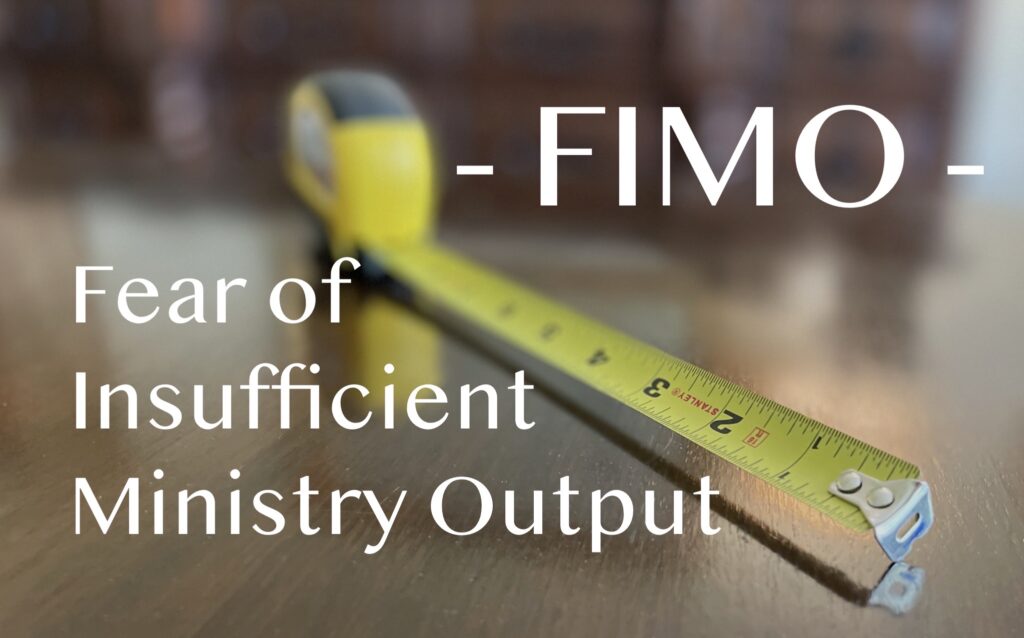
DEFINING FIMO
You may have heard of FOMO—Fear of Missing Out. But if you’re anything like me, you might be living in the grip of FIMO.
FIMO is characterized by a fixation on productivity and exacerbated by a flawed accounting of the work actually being accomplished. It’s a syndrome that has pushed me to keep working in the evenings and over weekends recently—because when I look back at my week, I sometimes wonder if I’ve actually logged enough hours to warrant the donations that feed this ministry. So I add more hours where I can. As often as I can.
I suffer from FIMO: Fear of Insufficient Ministry Output. Perhaps you to too.
After several months of ignoring the affliction, my own FIMO came back into focus a few days ago when a person I was consulting with on Zoom ended our call by asking me what I’m reading right now. It’s a question that typically evokes a mix of embarrassment, defensiveness, and a soupçon of shame in me. I braced for her reaction and gave my standard answer.
“Actually, I don’t read much anymore.”
Cue the disappointment on my interlocutor’s face. “You don’t . . . read?”
I understood her confusion. She’d requested an online consultation because she’d read my most recent book and wanted to debrief it. She’d also mentioned a number of my previously-published novels during our conversation. She knew me as a writer and was rather nonplussed that this writer wasn’t a reader.
I quickly explained to her that I do, in fact, read. A lot. But my reading is professional in nature and usually not long-form. It’s informational articles and excerpts from longer tomes and summaries of recent research—all in the area of study that is central to my work.
FIMO is a persuasive and depriving force. It’s a small voice in my conscience that tells me that reading for fun robs me of time I should be committing to ministry. That reading for fun is self-focused and doesn’t serve the needs of others. That reading for fun is too trivial and ephemeral to be of any value.
That voice’s influence is exacerbated by an equally powerful trait found in so many ministry workers: an inaccurate measurement of what our output actually is.
RESISTING FIMO
Here’s the problem so many of us face: We tend to measure ministry output in finished products and final performances—not in the hours and days of work it takes to get us there. It’s like counting loaves of bread, but not the process it takes to gather the ingredients, weigh them, mix them, knead them, let them rise a couple times, then bake them. (Can you tell I’m in my sourdough era?)
That’s probably because we assume that people around us are using the same inaccurate metrics we are—looking at what we produce, not at what it takes to get there—and measuring our ministry by what they see.
This simplistic way of assessing our work is not an accurate measurement of our productivity. It is a dangerous perspective that leads to feelings of inadequacy, self-recrimination, and often—in an effort to counter both—burnout. It’s a near-constant pressure that inhibits our flourishing.
If Fear of Insufficient Ministry Output is so chronic in your life that it’s beginning to have a detrimental impact on your health and wholeness (mental, physical, spiritual), please hear me: Your wellness is important. Your relationships are important. You are important. Important enough to seriously reassess the motivations and lies that drive you.
Your ministry isn’t “just”:
-
-
- The talk you give
- The article you post
- The session you lead
- The conference you keynote
- The sermon you preach
- The food you deliver
- The books you print
- The event you host
-
If we measure our effectiveness by the number of loaves we produce and don’t include the process it took to get there, we put ourselves at risk of debilitating FIMO.
Yes, we must be good stewards of our time. Yes, our work output must align with organizational and practical expectations. But we must measure productivity wholistically. Resisting FIMO requires that we consider the entire process as we assess the sufficiency of what we do.
-
-
- The brainstorming about future projects
- The research on topics we need to explore
- The conversations with people who are questioning their faith
- The emails we compose offering insight and guidance
- The editing process for an article we’re writing
- The Zooms and phone calls to plan for future engagements
- The multiple drafts in preparation for webinars
- The one-of-kind inventions that support our one-of-a-kind work
- The coffee & conversation with a new ministry partner
- The YouTubing that teaches us how to edit sound and video
- The planning and fine-tuning of travel arrangements
- The crowdsourcing and surveying that contribute to our understanding
- The writing and formatting of brochures and newsletters
- The organizing and cleaning that keep community spaces welcoming
- The reading and learning that keep us abreast of current concerns
- The drives and plane rides that get us to our destinations
-
DEFEATING FIMO
I know that what I’ve been baking in the kitchen of my ministry is good, important, and worthy. But I’ve been assessing it all wrong, and the strain caused by ignoring the process and counting only the loaves sometimes feels overwhelming.
This is my entreaty to fellow ministry workers whose output compass, like mine, tends to point to “not enough”:
Count it all—not just the finished product and final performance. Remind yourself that your workload is more than what others see. And give yourself grace for all the unseen you juggle, so you can carve out enough space for the life outside of work you also need to flourish.
It is up to us to align our expectations with our loving Father’s, to set healthy boundaries for us and for our ministry, and when we reach them, to declare it “Enough.”
There’s a novel on my nightstand. A Christmas gift from my niece. It’s dusty and unread. I’m going to crack the cover right now and rediscover fiction.
[A related article on Disordered Work Ethics among MKs and missionaries is HERE.]
Please join the conversation!
-
- Contribute your thoughts in the comments section below
- Use the social media links to Like and Share this article
- Many of these articles are now available in podcast form. Simply search for “Pondering Purple” on your usual pod platforms, or click this link to be taken to its host page
- To subscribe to this blog, email michelesblog@gmail.com and write “subscribe” in the subject line
- Pick up Of Stillness and Storm (my novel about a missionary calling gone awry) on Amazon
Shary Hauber
Good post. Yes FIMO can be a problem. Priority can help us realize where our ministry value is, not the hours we put into it. Putting in less hours does not mean it is insufficient.
Rachelle
Such a good reminder! Thank you Michèle! I would also add the endless figuring out of administrative processes that allow you to keep doing your ministry to that list, especially if you live cross-culturally (although there can be some crazy paperwork even if you minister in your passport country)! 😌
Bev Hawkins
Great read (as usual!) and definitely something I’ve struggled with as an artsy type in ministry. I think you forgot a couple of the most important things on the “Your ministry isn’t just:….” list — how many discipling relationships do I maintain regularly and how many people have come to Christ because of my ministry. These are metrics that even many missions use and can feel like a pressure point to someone who is not in direct evangelistic, discipling, soul-winning kind of ministry. Thankfully, our mission is beginning to address this (one tactic is talking about the Engel scale and realizing that there is much more to conversion than the moment of decision). Thankfully also, many supporters also understand this (though not all, unfortunately). I’ve found it helps to have a few people around you (whether mission leaders, or mentors, or coaches, or close family/friends) who will help you evaluate objectively the work you do, the time it takes, the “worth” of any given kind of work (because let’s face it, we all occasionally get wrapped up in something that consumes our energy that isn’t really worth doing) and where you can be best using your God-given gifs.
michele
These are excellent points, Bev! Thank you for contributing these lessons learned from so many years in the trenches!
Oyekale Oyeshola Samson
Thank you Michele for this insight it has enlivened my spirit as am constantly feeling as though am redundant and that something drastic should be done to do more. However, your write up has encouraged me to look through the process to the finished product. We run a major mission outreach yearly tagged Christmas in the Jungle in December, the program lead us to plant churches in unreached and unchurched places, all through the year we mobilize resources to get the churches planted at least three of such built and place a pastor on the church and continue to see to their growth. This is what we do but I personally am filling I need to do more and now this write up. Thanks@Missionary Purse Ministry International